Bounce Rate Explained: What It Means and How to Read It

Alexander Vermeer

Few analytics terms get misunderstood as often as bounce rate. People treat a high number as a disaster and a low number as a victory, but the truth is more nuanced. Once you know what bounce rate really measures, you can read it correctly and stop chasing the wrong goals.
This guide explains what bounce rate is, how it is calculated, and what a “good” number actually looks like.
What Is Bounce Rate?
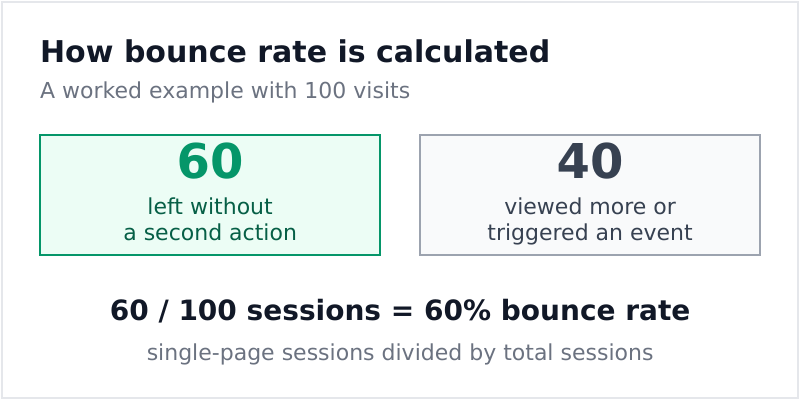
Bounce rate is the percentage of visitors who land on a page and leave without taking any further action. In classic analytics, a “bounce” is a single-page session: someone arrives, looks at one page, and exits without clicking to a second page or triggering any other tracked event.
The formula is simple:
Bounce rate = (single-page sessions / total sessions) × 100So if 100 people visit a page and 60 of them leave without doing anything else, the bounce rate is 60%.
Why Bounce Rate Is Often Misunderstood
Here is the catch: a bounce is not always a bad thing. Imagine someone searches for your opening hours, lands on your contact page, finds the answer, and leaves happy. That counts as a bounce, even though the visit was a success.
This is why bounce rate needs context. A high number on a blog post might mean the reader got what they needed. On a checkout page, however, a high number is a genuine warning sign. The same metric tells two very different stories depending on the page.
It is also worth noting that newer analytics tools have shifted toward “engagement rate” as the headline metric. Engagement rate looks at whether a visit was meaningful, rather than simply counting single-page exits. The two ideas are related, but engagement rate often gives a clearer picture of value.
What Is a Good Bounce Rate?
There is no single magic number, because it depends heavily on the type of page and the source of traffic. Still, these rough ranges give you a sense of what is typical:
| Page type | Typical range |
|---|---|
| Blog or article pages | Higher (people read and leave) |
| Landing pages | Varies widely by intent |
| Service or product pages | Lower is usually better |
| Contact or info pages | Higher is often fine |
Instead of comparing yourself to industry averages, watch your own trend over time. A sudden jump in bounce rate is far more telling than the raw number itself.
What Causes a High Bounce Rate?
When a high bounce rate genuinely signals a problem, the cause usually falls into one of these buckets:
- Slow loading: Visitors leave before the page even appears.
- Mismatched expectations: The page does not match what the visitor was promised.
- Poor mobile experience: Layout or buttons are hard to use on a phone.
- Weak calls to action: Nothing invites the visitor to take the next step.
- Tracking gaps: Important interactions are not being recorded as events.
That last point matters. If your setup does not measure key actions, perfectly engaged visitors can look like bounces. Reviewing your tracking is a smart first step. Our guide on why analytics data goes wrong covers common measurement mistakes that distort numbers like this.
How to Use Bounce Rate Wisely
Bounce rate is most useful when you pair it with other signals rather than reading it alone. Combine it with time on page, scroll depth, and conversions to understand what visitors actually do. Looking at bounce rate by traffic source also helps, because it shows which channels send engaged visitors and which send drive-by clicks. This works especially well alongside audience segmentation.
For a deeper definition, the official analytics documentation explains how modern tools handle engaged versus non-engaged sessions.
The Takeaway
Bounce rate is a helpful signal, not a verdict. A high number can mean a problem or a satisfied visitor, depending on the page. Read it in context, track your own trends, and combine it with other metrics. Do that, and bounce rate becomes a tool that points you toward real improvements instead of a number that makes you panic.

Alexander Vermeer
Web analytics specialist with over 8 years of experience implementing tracking solutions for businesses of all sizes. Passionate about helping companies make sense of their data without drowning in complexity. When not debugging GTM containers, you'll find me advocating for privacy-respecting analytics approaches.