Attribution Models Explained: Beyond Last-Click

Alexander Vermeer

Most customers do not buy the first time they hear about you. They see an ad, read a review, click an email, and finally convert days later. So when the sale happens, which of those touchpoints deserves the credit? That question is what attribution models are designed to answer.
This guide explains the main attribution models in plain terms, so you can pick the one that fits how your business actually works.
What Are Attribution Models?
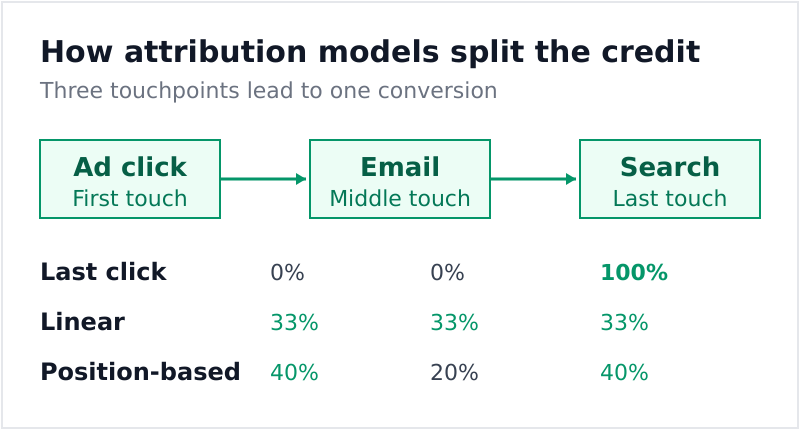
Attribution models are rules that decide how credit for a conversion is shared across the different marketing touchpoints a customer interacted with. Some models hand all the credit to a single touchpoint, while others spread it across the whole journey.
The reason this matters is simple: the model you choose shapes which channels look successful. Pick the wrong one, and you might cut a campaign that was quietly doing great work behind the scenes.
The Main Attribution Models
There are several common attribution models, and each tells a slightly different story about the same customer journey. Here is how the most popular ones work:
| Model | How credit is assigned | Best for |
|---|---|---|
| First click | All credit to the first touchpoint | Measuring awareness |
| Last click | All credit to the final touchpoint | Measuring closers |
| Linear | Credit split evenly across all touchpoints | Valuing the full journey |
| Time decay | More credit to touchpoints closer to the sale | Longer sales cycles |
| Position-based | Most credit to first and last, rest shared | Balancing start and finish |
Notice that no model is “correct” in an absolute sense. Each one simply emphasizes a different part of the journey.
Single-Touch vs. Multi-Touch
Attribution models fall into two broad families. Understanding the split makes the rest easier to follow.
- Single-touch models give 100% of the credit to one touchpoint. First click and last click are the classic examples. They are easy to understand but ignore everything in between.
- Multi-touch models share credit across several touchpoints. Linear, time decay, and position-based all fall here. They are more realistic but harder to set up and read.
If you are just getting started, a single-touch model is a fine place to begin. The most common starting point is last click attribution, which we cover in detail in its own guide.
How to Choose a Model
The right model depends on your business, not on what sounds advanced. Ask yourself a few questions:
- How long is your sales cycle? Short cycles suit single-touch models. Long cycles benefit from time decay.
- How many channels do you use? If most sales come from one channel, simple models work fine. Many channels call for multi-touch.
- What decision are you making? Judging awareness campaigns needs first click. Judging closers needs last click.
A practical tip: do not obsess over finding one perfect model. Many teams view their data through two or three models side by side. The contrast between them often reveals more than any single view could.
Attribution and Clean Data
No attribution model can fix messy tracking. If your touchpoints are not tagged consistently, every model will give you misleading results. This is where structured campaign tracking helps. Tagging your links with UTM parameters ensures each touchpoint is recorded clearly, so your chosen model has reliable data to work with.
It is also worth knowing that privacy changes have made attribution harder. As cookies fade out, some touchpoints become invisible, which can skew the credit. The official attribution documentation explains how modern tools adapt to these gaps.
The Takeaway
Attribution models are lenses, not laws. Each one highlights a different part of the customer journey, and the best choice depends on your sales cycle, your channels, and the question you are trying to answer. Start simple, compare a couple of models, and keep your tracking clean. Do that, and you will spend your budget on the channels that genuinely move the needle.

Alexander Vermeer
Web analytics specialist with over 8 years of experience implementing tracking solutions for businesses of all sizes. Passionate about helping companies make sense of their data without drowning in complexity. When not debugging GTM containers, you'll find me advocating for privacy-respecting analytics approaches.